For regular group lessons refer to a calendar below
For private lessons contact Kristina 425.749.0989
For dance show performance at your event email ivanova777@gmail.com
For private lessons contact Kristina 425.749.0989
For dance show performance at your event email ivanova777@gmail.com
Group lessons:
$30/person drop-in
Private lessons:
$80 per 1-class (60 minute)
$300 a package of 4-classes
+ $15 floor fee applies to all private lessons
contact for availability 425.749.0989 (Kristina) or ivanova777@gmail.com
$30/person drop-in
Private lessons:
$80 per 1-class (60 minute)
$300 a package of 4-classes
+ $15 floor fee applies to all private lessons
contact for availability 425.749.0989 (Kristina) or ivanova777@gmail.com
Argentine tango has taken away many hearts. Music, embrace and connection set this dance apart from many other dances. I found myself in love with tango right at my first dance lesson, and have never stopped loving it since. Argentine tango, even if for a moment, brings out the whole spectrum of emotions and feelings. For some, it may be passion, love, or desire. For others, it can be joy, happiness, or freedom. Through this dance, we all discover our own unique connection to what inspires us. By dancing, we keep sharing our inspiration with those with whom we come in touch. Tango is a big part of my life, and it is a joy for me to share my passion with you.
I specialize in teaching traditional Argentine tango (Tango-Salon and Tango-Milonguero styles as well as Tango-Nuevo) to students of all levels from absolute beginners to advanced level.
I specialize in teaching traditional Argentine tango (Tango-Salon and Tango-Milonguero styles as well as Tango-Nuevo) to students of all levels from absolute beginners to advanced level.
Course: Argentine Tango (1A and 1B)
|
Course AT1A
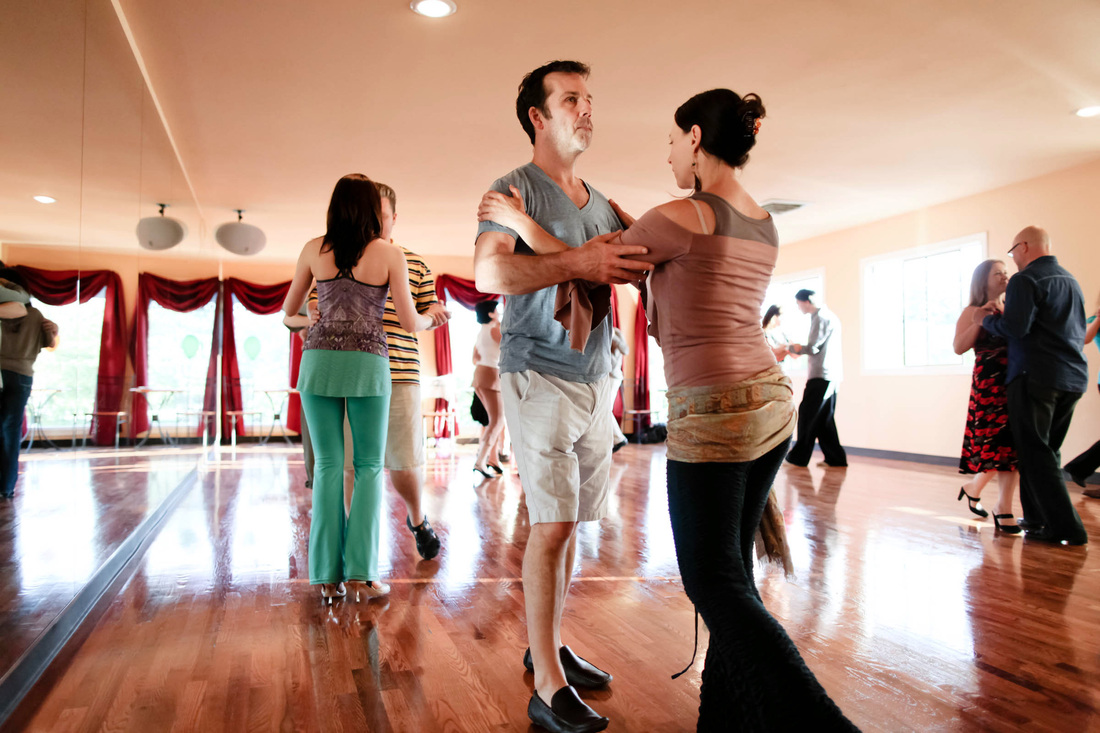
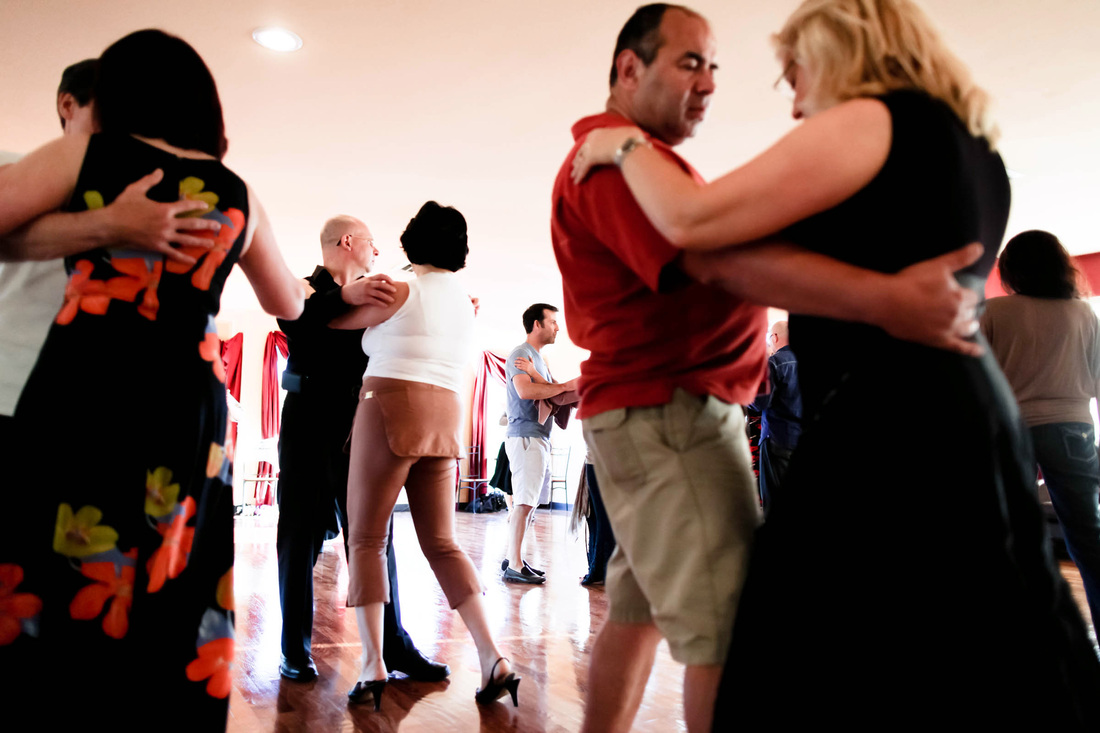
Class 1. Learning and practicing "La Caminata" (the tango walk) and the rock step in parallel system. Focus on change of weight, posture, and connection. Class 2. Learning and practicing the turns and "la caminata" in parallel system. Focus on body mechanics and connection. Class 3. Learning "La Salida Cruzada" (walking into the cross) in parallel system. Focus on the correct connection and technique. Class 4. Practicing la Salida Cruzada with the resolution in a front ocho. Focus on the technique of the front ocho. |
Course AT1B
Class 1. Learning and understanding the difference between open and close embrace in tango. Applying material learnt in course AT1A, practicing to dance in various embraces. Class 2. Learning and practicing "Ocho Cortado" in parallel system. Focus on the correct connection and technique. Developing presence between the dance partners, as well as focusing on lady's footwork. Class 3. Learning "the back ocho", and practicing la caminata with the back ocho. Focus on the body mechanics and technique of "the back ocho". Class 4. Changing systems: parallel and cross, and creating dance sequences out of known dance elements. |
Course: Argentine Vals (1A and 1B)
|
Course AV1A
Class 1. Introduction to the fundamentals of tango in general and vals in particular: body mechanics and posture, embrace, steps. Class 2. Understanding the musical structure of vals, adopting the body movement to the rhythm. Learning basic dance sequences. Class 3. Learning and practicing the commonly used turns. Fundamental technique of the turn (giro), adapting the body to various timing and speed of the turn. Class 4. Exploring and practicing more dance sequences that include turns. |
Course AV1B
Class 1. Refreshing and practicing material learnt in course AV1A. Class 2. Exploring more advanced dance sequences commonly used in tango-vals. Class 3. Focusing on musicality of various tango-valses and adapting dance sequences to the music. Understanding the timing and speed of distinct valses. Class 4. Learning how to start to use our imagination and creativity to produce a new dance sequence by combining one dance element with another: improvisation. |
Course: Argentine Milonga (1A and 1B)
|
Course AM1A
Class 1. Introduction to the fundamentals of tango in general and milonga in particular: body mechanics and posture, embrace, steps. Class 2. Learning and practicing the basic milonga "box" sequence. Understanding the rhythm of milonga dance. Class 3. Learning and practicing the commonly used milonga variations. Fundamental technique of adapting the body to the timing of the milonga music. Class 4. Introduction to a musical rhythm of the Milonga Lisa and its dance variations. |
Course AM1B
Class 1. Refreshing and practicing material learnt in course AM1A. Dancing in the musical rhythm of Milonga Lisa. Class 2. Introduction to a musical rhythm of the Milonga con Traspie. Fundamentals of Traspie step. Class 3. Learning and practicing various Traspie steps. Class 4. Learning and practicing various combinations with Traspie and Lisa rhythms. |
Course: Follower Tango Technique
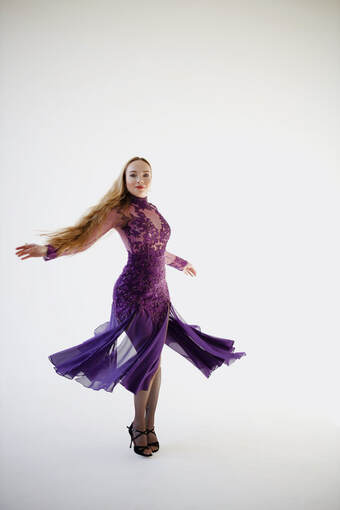
Technique is essential—but tango truly comes alive when it moves through your body in space. Whether your goal is social dancing or performance, this class helps you connect technique with musicality, flow, and presence.
In this class, we will:
• Practice tango elements, including embellishments.
• Develop dynamic balance, control, and fluid transitions
• Work on posture, elegance, and grounded movement
• Explore musicality and expressive quality in your dance
This is where your dance becomes more alive, adaptable, and connected.
Refer to the calendar for schedule and location.
Please wear fitness-like clothing (bring socks and tango-heels shoes)!
Inspirational quote: "Technical excellence and aesthetics in dance are not just about talent, they are the result of focused and intentional work."
Let’s expand your movement and expression together!
Course: Tango Musicality Series
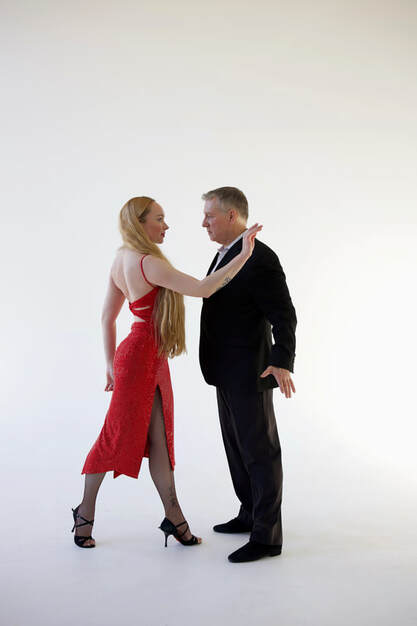
Tango Musicality Class – Dancing D’Arienzo
In this class, we will work on specific tango sequences inspired by the music of Juan D'Arienzo — rhythmic, sharp, playful, and full of dynamic contrast.
Together we will explore:
• staccato movement quality
• pauses, stops & accelerations
• variación and rhythmic repetition
• musical interpretation through body movement
Our goal is not only to “dance the steps,” but to adapt our body movement, emotional presence, and connection in the couple to the character of the music — so we truly express what we hear.
This class is designed for intermediate level dancers who want to deepen their musicality, responsiveness, and expressive range in tango.
This series is built as a progressive 4-week program, where each class develops and expands on the previous material. For this reason, registration is required for the full series. If you miss a class, you will receive a demo video with explanations so you can continue practicing at home.
For location and dates refer to calendar.
Course: Argentine Tango-Nuevo (1A and 1B)
There are many controversies, as well as different opinions whether Tango-Nuevo style can be truly called Argentine Tango, or it has lost the essence of Tango. To me, Tango-Nuevo as a dance style is one of many ways to express Tango music. We need to remember that everything evolves and eventually take new forms to adapt and grow.
"Nuevo" in Spanish means "New". Stemming from traditional Tango of the Golden Age and inspired by the evolution of the Tango music, the new Tango style has evolved with a new era of Tango music.
Being at the forefront of this development in music, Astor Piazolla incorporated elements of jazz and classical music into traditional Argentine Tango music. By doing so, he revolutionized existing tango music into a new style called "Tango-Nuevo". From this point in time, many more musicians, such as Gotan Project, Carlos Libedinsky, and others continued to explore and develop new tango music.
Nowadays, Tango-Nuevo (alternative tango) includes the whole range of music: classical Tango-Nuevo (Piazolla, Gotan Project), Argentine folkloric music (Tamara Castro, Mercedes Sosa), modern tango bands (Otros Aires, Bajofondo), as well as non-tango music (pop, rock, jazz).
With more Tango-Nuevo music emerging, the tango dance itself started to change in order to fulfill expression of the music. A need for developing more complex movements and enriching the dance leads its forerunners and enthusiasts to restructuring and reanalyzing traditional Argentine tango. Such dancers as Gustavo Naveira, Fabian Salas and Pablo Veron played a leading role in bringing it up to what now is known as Tango-Nuevo style. However, they have never claimed to invent a new style, rather they claimed to bring a new vision in Tango. Read more about Gustavo Naveira and evolution of tango
General characteristics of Tango-Nuevo dance: open, loose or elastic embrace with a very upright posture and a great emphasis on the dancers maintaining their own axis. Some of the most identifiable figures of the style are overturn ochos, cadenas, linear boleos, volcadas and single axis spins.
I recommend that you start studying the Tango-Nuevo after at least 1 year studying and dancing traditional tango in close embrace. Since Tango-Nuevo uses fundamental tango concepts and builds upon them, and then it will be easy for you to bring innovation and personal expression into the dance that you already have.
"Nuevo" in Spanish means "New". Stemming from traditional Tango of the Golden Age and inspired by the evolution of the Tango music, the new Tango style has evolved with a new era of Tango music.
Being at the forefront of this development in music, Astor Piazolla incorporated elements of jazz and classical music into traditional Argentine Tango music. By doing so, he revolutionized existing tango music into a new style called "Tango-Nuevo". From this point in time, many more musicians, such as Gotan Project, Carlos Libedinsky, and others continued to explore and develop new tango music.
Nowadays, Tango-Nuevo (alternative tango) includes the whole range of music: classical Tango-Nuevo (Piazolla, Gotan Project), Argentine folkloric music (Tamara Castro, Mercedes Sosa), modern tango bands (Otros Aires, Bajofondo), as well as non-tango music (pop, rock, jazz).
With more Tango-Nuevo music emerging, the tango dance itself started to change in order to fulfill expression of the music. A need for developing more complex movements and enriching the dance leads its forerunners and enthusiasts to restructuring and reanalyzing traditional Argentine tango. Such dancers as Gustavo Naveira, Fabian Salas and Pablo Veron played a leading role in bringing it up to what now is known as Tango-Nuevo style. However, they have never claimed to invent a new style, rather they claimed to bring a new vision in Tango. Read more about Gustavo Naveira and evolution of tango
General characteristics of Tango-Nuevo dance: open, loose or elastic embrace with a very upright posture and a great emphasis on the dancers maintaining their own axis. Some of the most identifiable figures of the style are overturn ochos, cadenas, linear boleos, volcadas and single axis spins.
I recommend that you start studying the Tango-Nuevo after at least 1 year studying and dancing traditional tango in close embrace. Since Tango-Nuevo uses fundamental tango concepts and builds upon them, and then it will be easy for you to bring innovation and personal expression into the dance that you already have.
|
|
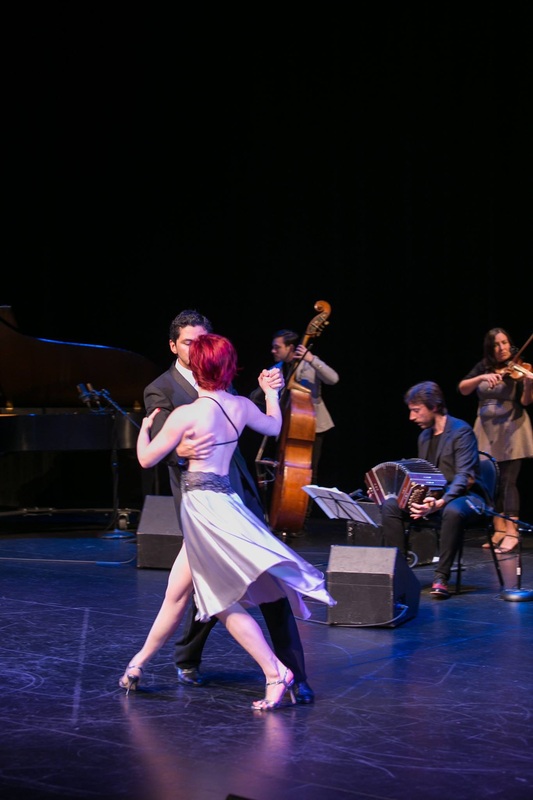
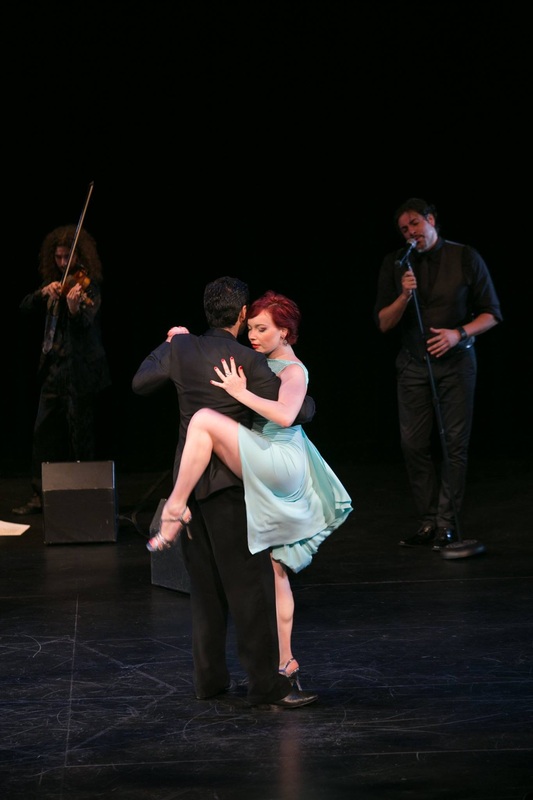
Photo: Jennifer Richard, Roger Trajano, Kristina Ivanova. All rights reserved (c) 2019
Website content and design: Kristina Ivanova. All rights reserved (c) 2019
Website content and design: Kristina Ivanova. All rights reserved (c) 2019